What the panel shows
A short keyboard whose keys carry Braille dots, plus one lit indicator. The Blind Monkey reads the Braille number and plays, the Deaf Monkey reads the colour, and the Mute Monkey holds the page.
Sources: In-game module manual
The keys carry a Braille scale number and a light shows one colour. That pair returns four notes, played in the order printed. A wrong attempt changes the light, so the pair has to be read again.
| Braille number | Green light | Blue light | Pink light | Yellow light |
|---|---|---|---|---|
| 1 | C D E F | E E F G | C D E C | C E G C |
| 2 | G A B C | A E A B | G E E F | F A C F |
| 3 | E F G A | C D C E | C C G G | G B D G |
| 4 | D F A D | G C G E | E D C D | E C D G |
| 5 | C G C G | B G A B | A B C A | A G A F |
| 6 | F E D C | D E D C | G F E D | B A G F |
| 7 | G B A G | A B A G | B F G A | D C B A |
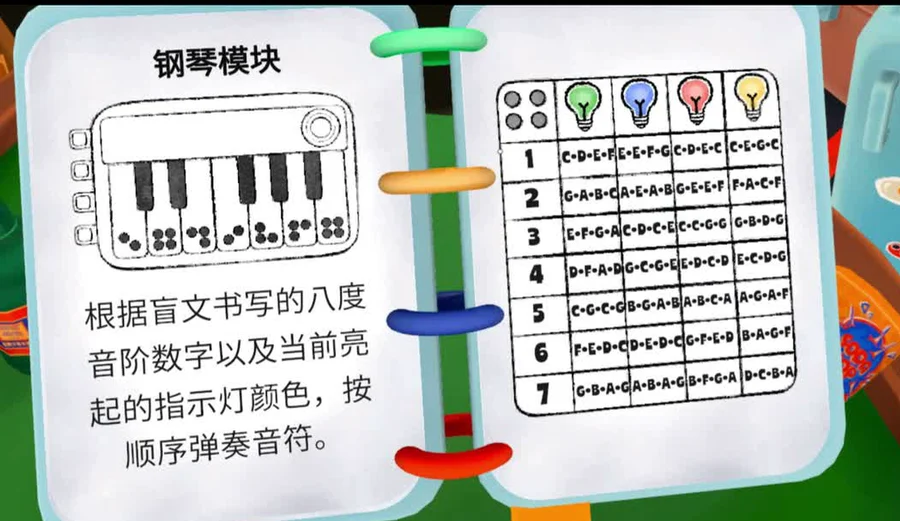
A short keyboard whose keys carry Braille dots, plus one lit indicator. The Blind Monkey reads the Braille number and plays, the Deaf Monkey reads the colour, and the Mute Monkey holds the page.
Neither the number nor the colour is an answer on its own. Seven numbers and four colours make 28 rows of four notes, so a team working from the colour alone is choosing between seven different runs.
Every cell holds exactly four notes, and the order is the instruction. Reporting the set of notes without the order turns a four-note run into a search, and the panel does not accept a set.
A rejected attempt changes the lit colour, which changes all four notes. The panel therefore has to be re-read rather than resumed, and the first thing to check after a wrong note is whether the light is still the colour the team is working from.
The handwritten page distinguishes C from G by a single stroke, and a misread note is invisible until the attempt is rejected. Reading the four notes back to the Mute Monkey before playing is cheaper than debugging them afterwards.
The table above matches the in-game manual page, and the narration in the same clip confirms one cell: a blue light with Braille 3 returns C D C E. The caption calls the third column pink rather than red; follow the in-game colour, not the word.
It changes between attempts, which is why a panel has to be re-read after a wrong note rather than resumed.
Labels. The Braille number on the keys is stable, and the notes themselves are the instruction; a counted position is not.
Four, in a fixed order. Every entry on the manual page is a four-note run.
Read the Braille scale number on the keys and the one lit colour, look up the four notes for that pair, and play them in the printed order. Re-read the light after any rejected attempt.
This is an independent fan-made resource and is not affiliated with Lefto Studio. Facts on this page link to their sources above.