What to know
What the panel shows
Several displays, each looping a five-signal pattern, plus an indicator for the slot the game is asking about. The Blind Monkey hears the tones, the Deaf Monkey watches the flashing buttons, and the Mute Monkey holds the page.
Sources: In-game module manual
The page is not International Morse
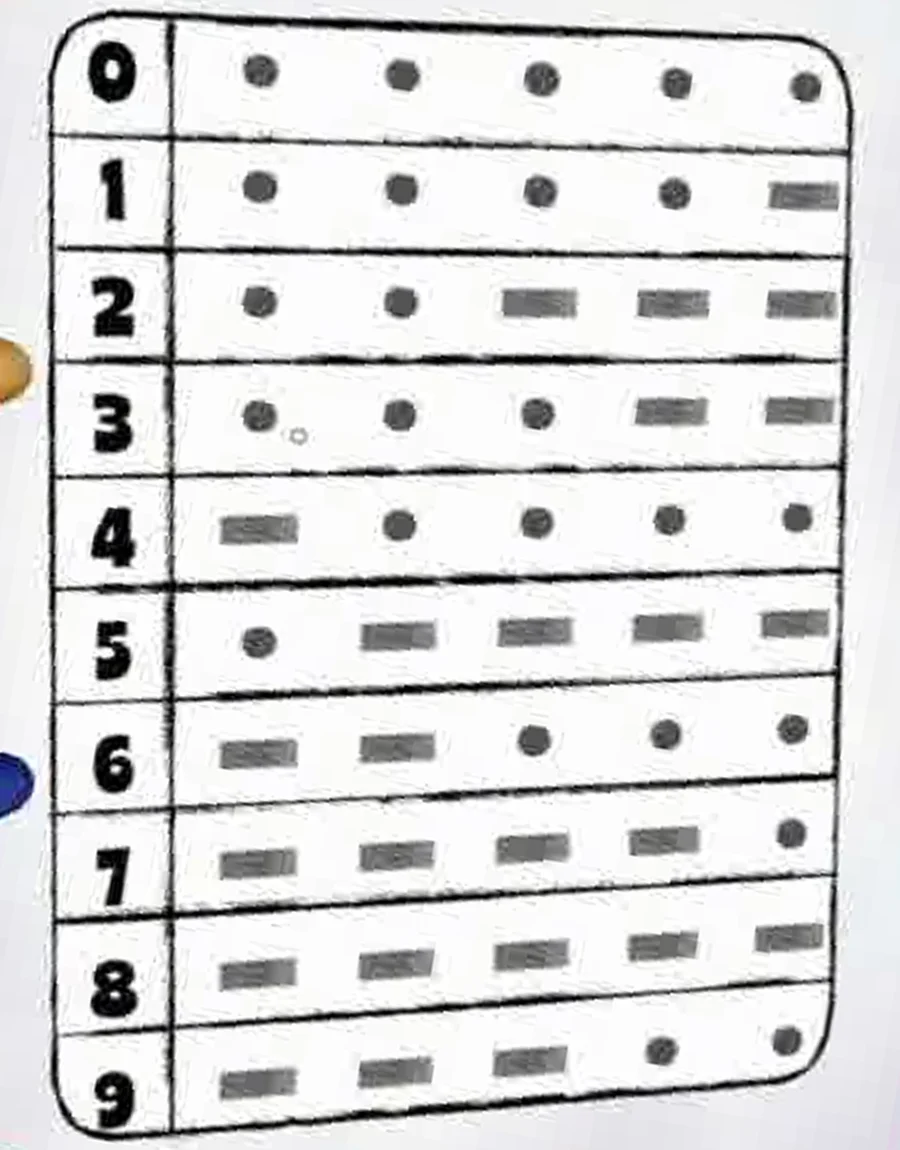
The manual's patterns are a permutation of the standard digits rather than the standard itself. Five dots is 0 here and 8 in International Morse; five dashes is 8 here and 0 there. The recorded tutorial says this outright: check the manual, because the in-game code is not the real one.
Sources: In-game module manual
Knowing Morse is a handicap
A player decoding from memory will answer quickly and wrongly on most rows. The only reliable procedure is to count the five signals and read the row, which is slower and correct. Treat a confident instant answer from a Morse-literate player as a warning sign.
Sources: In-game module manual
Rows that differ by one signal
0 is five dots and 1 is four dots plus a dash; 7 is four dashes plus a dot and 8 is five dashes; 8 and 9 differ only in the last two signals. Because the page is a permutation, the near-miss pairs are not the pairs a Morse reader expects, so the final signal has to be heard before any digit is named.
Sources: In-game module manual
A digit belongs to a slot
The panel wants each digit attached to the display it came from, so the unit of report is a pair: slot two is seven. A bare digit has to be re-derived, and the loop may already have moved on.
Sources: In-game module manual
Enter only when every slot is confirmed
A full module is four digits, which is twenty separate dot-or-dash decisions. Confirming with three good digits and one guess is how this module produces a strike, and the displays keep looping, so a guess also costs the time to re-read it.
Sources: In-game module manual
Where the table comes from
The table above was read from the in-game manual page across three separate frames of the same shot, with every one of the fifty cells classified by signal shape rather than by eye. It matches no published edition of International Morse by design, which is the point of the module.
Sources: In-game module manual